

Disputes may happen occasionally when living in a close community. It can be between:
- two or more residents
- resident/s and the village operator
- resident/s and a village committee
- a village committee and the village operator
Many disputes are just misunderstandings. They can often be handled with open and respectful communication. Sometimes the other person is unaware of the problem and is happy to help to find a solution.
A village dispute resolution procedure is covered in the Retirement Villages Regulations 2026. You should use this process before seeking external intervention.
Steps to resolve it together first
Try these steps to resolve conflicts in your village,
- Talk it out together: Explain the problem and how you feel. Avoid personal or attacking comments.
- Listen to the other side: Give the other person a chance to share their view.
- Check the village rules: Are there rules about the problem e.g. keeping pets, number of car parking bays, etc.
- Be respectful: Stay calm. Focus on the problem, not the person.
- Take notes: Document all details of the discussion, including dates and times.
- Get help: Ask the village manager, Village Retirement WA or an independent person to mediate if you need help.
Formal dispute process
Each village must have a documented dispute resolution process including the following steps.
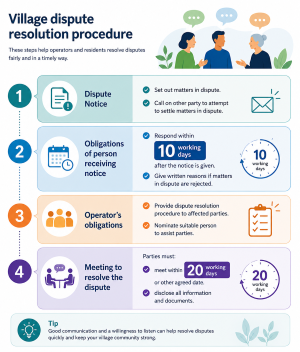
The dispute process must be available to all residents.
The operator or a resident can start the dispute process.
You can change the formal process if:
- the operator agrees; and
- the change is approved by a special resolution at a residents' meeting.
The people involved in the dispute are formally called 'party' or 'parties'.
Anything said, done or written during the dispute process is confidential. Nothing can be shared without everyone's agreement.
Step 1: Making the complaint - dispute notice
You must issue a dispute notice by writing to the other party involved in the dispute:
- explain the problem and how it affects you
- ask them to address it.
Write to the village operator to let them know about the dispute if they are not already involved.
Step 2: Response from the other party
The other party must write back:
- within 10 working days
- acknowledging the dispute notice
They must include any reasons they reject the complaint or their responsibility in solving the problem.
Step 3: Resolution support - village operator response
The village operator must:
- provide the dispute resolution procedure to everyone involved
- explain available options for resolution
- nominate a suitable person to help resolve the dispute
- respond in writing to any dispute notice and acknowledge the solutions being sought
- document the dispute process, this includes making notes of all meetings, discussions, and written correspondence.
Nominated person
The nominated person should:
- not be involved in the matter
- be impartial to both sides of the dispute
- be given all relevant documents and information about the dispute
Step 4: Resolution meeting
The nominated person must organise a meeting within everyone involved in the dispute.
The meeting must be held:
- within 20 working days of the dispute notice, unless a later date is agreed on
- at any place agreed to by everyone involved.
A support person can be brought to the meeting. The other party involved in the dispute must be informed of the support person’s name before the meeting.
When the process doesn't work - escalation options
There are two options when a dispute is not resolved through this process.
Any party may:
- apply to State Administrative Tribunal (SAT)
- lodge a complaint with Consumer Protection
Consumer Protection may provide early intervention or conciliation before escalating the dispute further.
Mediation
Mediation is when a neutral person (a mediator) helps parties in dispute reach an agreement.
Mediation is confidential. A financial penalty applies for disclosing information discussed during the process.
You or the operator can apply to have an external mediator appointed by the Commissioner for Consumer Protection.
This would only be needed if conciliation is unsuccessful.
The Commissioner must inform all parties within 10 working days of receiving an application of:
- an appointment of a mediator
- a refusal to appoint a mediator.
Appointment of a mediator
The Commissioner can require you to:
- attend mediation
- participate in good faith.
Mediation can be quite expensive. The costs are shared between the parties in the dispute, unless the Commissioner decides otherwise.
An operator cannot recover their mediation costs from the resident.
When the Commissioner refuses to appoint a mediator
The Commissioner may refuse mediation if:
- the matter is before a court
- village dispute resolution procedures were not attempted
- another resolution pathway is considered more appropriate, such as conciliation.
You can apply for a review of the decision if you are not satisfied with the Commissioner’s refusal to appoint a mediator.